8 Dec 2025
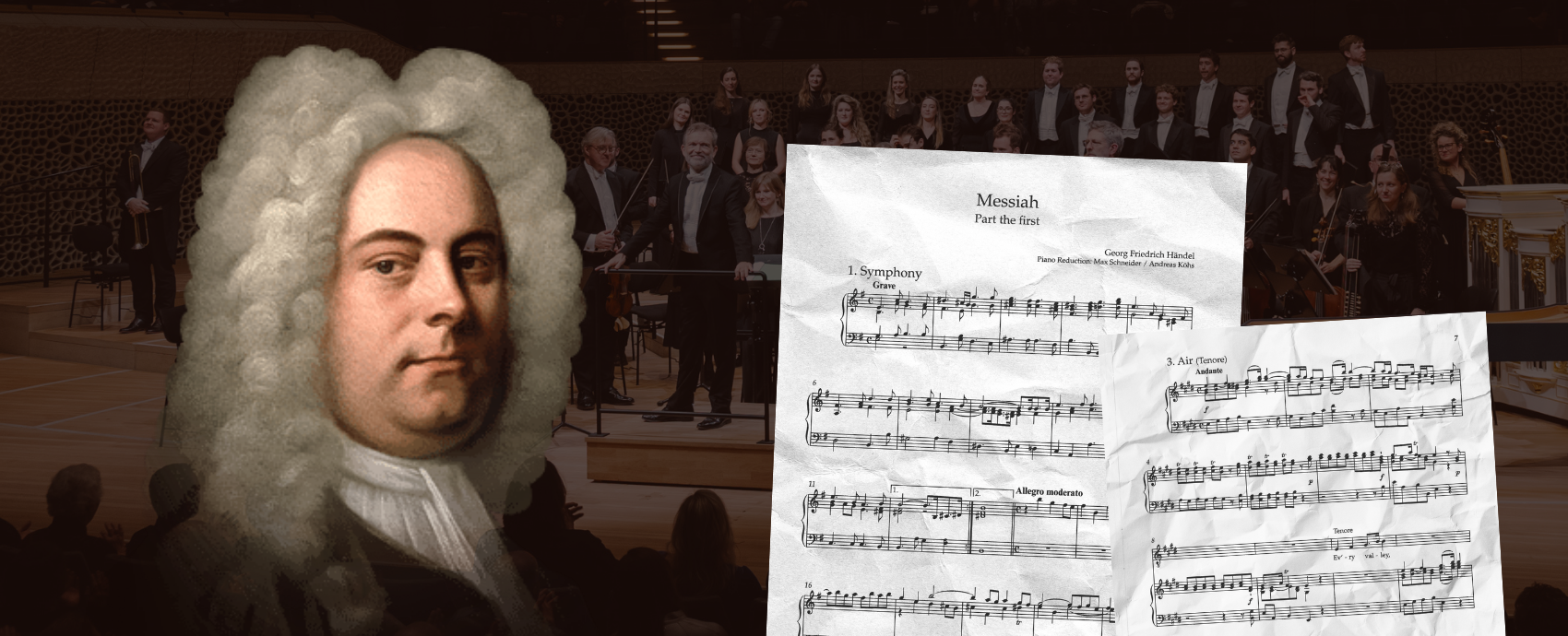
Think you know the story behind Handel’s masterpiece? Think again.
Messiah is one of the most celebrated works in music history. But its past is full of myths and misconceptions. Written by Ruth Smith, these are five of the biggest myths behind Handel’s Messiah.
Handel actually wrote down the draft in 3 weeks: which is still amazing. His usual time for composing an oratorio was about 6 weeks. His average productivity for Messiah was more than 12 pages of music per day. But maybe he could write so fast and so fluently because the libretto had been on his desk for 18 months, if, as seems probable, the ‘scripture collection’ which Charles Jennens offered him in winter 1739 was Messiah.
Handel also made alterations to the score throughout his life. The original of ‘But who may abide’ was a 6-bar recitative for bass, the bravura version being written in 1750 for the young star castrato Guadagni.
The persistent notion that Handel was bankrupt when he accepted an invitation to perform in Dublin is based on his having emptied his savings account.
But he had an annual stipend from the crown of £600, which was ample to live on in London (even in Mayfair). It translates to £170,000 in 2025.
He wasn’t financially bankrupt, and he wasn’t creatively bankrupt either; in the previous four years, counting only major works, he had composed nine full-length theatre works and the Twelve Concerti Grossi.
But he didn’t have sufficient cash reserves to underwrite one of his usual seasons of London performances. Dublin solved that problem.
Handel used three of his Italian duets for Messiah: they can be heard in ‘And he shall purify’, ‘For unto us a child is born’, ‘His yoke is easy’, ‘All we like sheep have gone astray’, ‘O death where is thy sting’, and ‘But thanks be to God’.
The duets are usually referred to as love duets. But none of the original texts is amorous. They meditate on the pain and disappointments of human love, and the transience of human life. We could speculate that setting such texts (two of the three only weeks before he began Messiah) naturally led Handel to take up a libretto concerned with Last Things.
Alas, no. ‘He was despised’ was in the draft score when Handel left for Ireland. He didn’t know that Susannah Cibber, tragedienne and singer, would be coming to Dublin while he was there. The sister of Handel’s English rival composer Thomas Arne, she had not previously worked with Handel, though she had sung his music.
Mrs Cibber was celebrated for her capacity to express grief and pathos. Handel was able to employ her in his second series of six concerts, and then for Messiah. He transposed two of the soprano arias for her, so that she had a lyrical aria in all three parts, including the final aria of the oratorio; ‘He was despised’ was already in her alto range.
The tradition of standing for the Hallelujah chorus is based on an anecdote by the political grandee Lord Kinnoull (1710-87):
‘when Handel’s Messiah was first performed, the audience were exceedingly struck and affected by the Musick in general; but when that Chorus struck up ‘For the Lord God omnipotent reigneth’, – they were so transported, that they altogether, with the King (who happened to be present), started up, and remained standing till the Chorus ended. And so it became the fashion in England, for the audience to stand up, while that part of the music is performing.’
Well… we have the records for George II’s attendance at theatre performances, including Handel’s operas and oratorios. According to which, he attended no Handel oratorio after 1739. The first London Messiah was in 1743.
However: Handel’s friend the Rev. George Harris noted in his diary, after attending one of Handel’s Messiah performances for the Foundling Hospital in 1750, that members of the audience rose to their feet for ‘some choruses’ (not just the Hallelujah chorus). The author Catherine Talbot (1721-70) witnessed the same at a performance in 1756. So if we do stand, we are joining hands across the centuries with Handel’s earliest Messiah audiences.
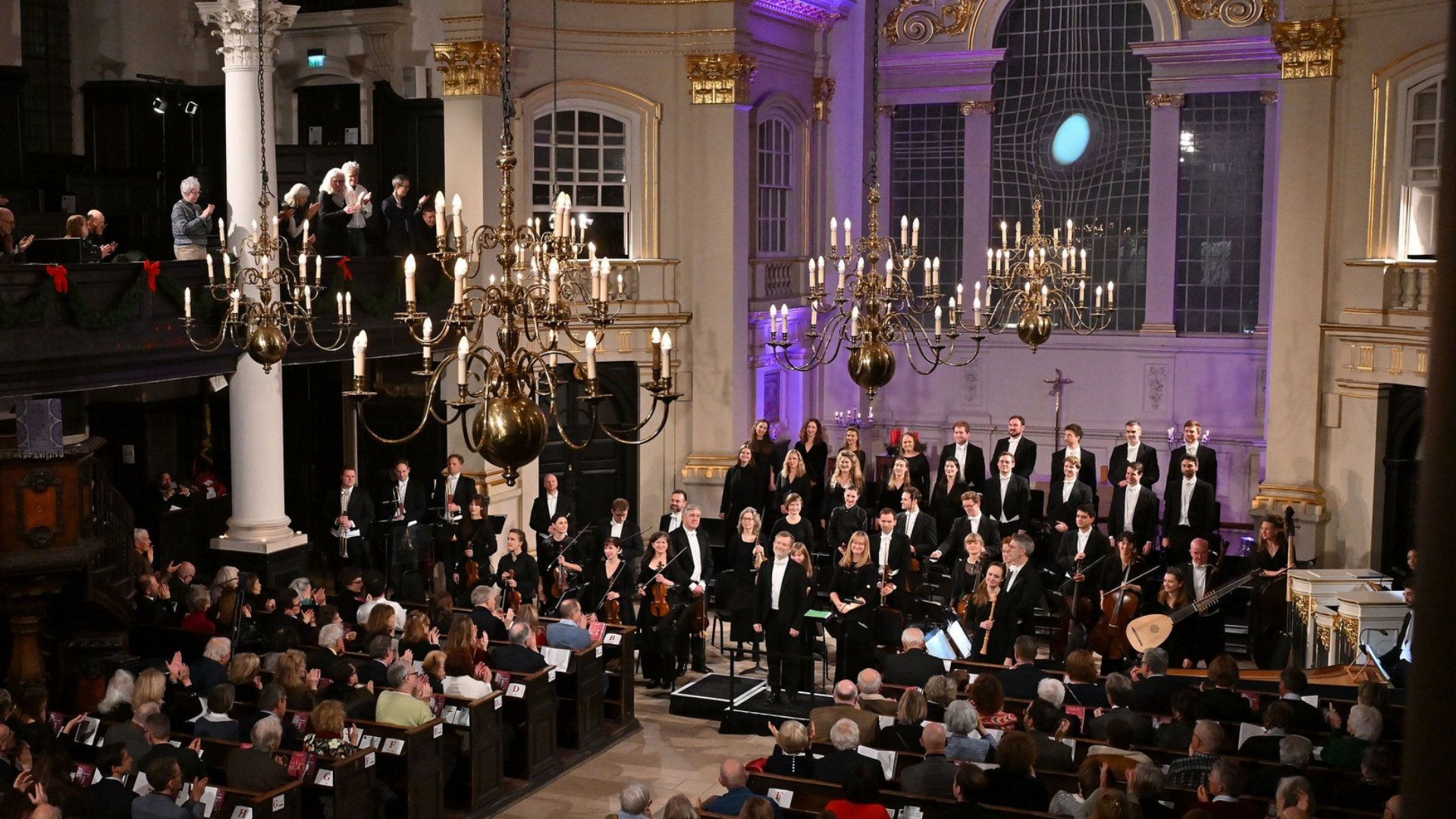
Christophe Rousset conducts the Monteverdi Choir and English Baroque Soloists at St Martin-in-the-Fields © Paul Marc Mitchell
Join us this December as we perform Handel’s Messiah with Christophe Rousset. This performance will replicate the rare direction of the Messiah performed in Covent Garden in 1752, the final Messiah Handel fully directed and the only time that a soprano, contralto, tenor and bass were used. This rare performance shall be brought back to life by acclaimed soloists Ana Vieira Leite, Dame Sarah Connolly, Andrew Staples and William Thomas.